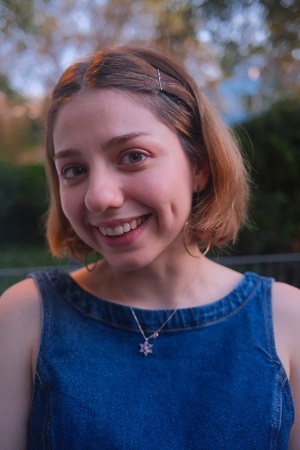
Research Spotlight: Ceren Eksi
Welcome to our new series where we feature our researchers in the RTG! To show and celebrate the people behind the science, we are shining a spotlight on the brilliant minds of our Research Training Group and sharing their research, their motivations, and what drives them to explore the fascinating world of emotional learning and memory.
Who are you, how long have you been part of the RTG, and what are you working on?
Hi! I am Ceren, a PhD student from the second cohort of the RTG, supervised by Prof. Tobias H. Donner. I completed my master's degree in Cognitive Neuroscience at Sapienza University of Rome and conducted my master's thesis at the Max Planck Institute in Leipzig.
I am working on manipulating pupil-linked phasic (i.e., fast) arousal by transcutaneous vagus nerve stimulation (tVNS) to understand the causal link between phasic arousal and memory processes. Alongside pupillometry and tVNS, I use MEG (magnetoencephalography) to track the cortical dynamics underlying arousal and memory.
How does working in an interdisciplinary team shape your thinking and your work?
Being part of an interdisciplinary team, including psychology, neuroscience, and psychiatry, has substantially improved both my project and my understanding of how to practice science. This environment particularly encourages me to think about the possible clinical implications of my work. Conducting my research with input from different disciplines increases the quality of the research as well as my own curiosity and motivation.
How has being part of this RTG shaped you in your role?
I feel very lucky to be part of our RTG: an interdisciplinary, supportive, creative, inspiring team. Thanks to the lecture series and methods academy, I am learning new skills, topics, and approaches that ultimately inspire my own research. I also found the lab rotation really useful: I learned a lot and appreciated the opportunity to spend time in a different lab and to meet with the PI and other lab members to discuss my research and hear about theirs. The relationships within the RTG are very valuable. As PhD students, we support each other and each other's projects, and as a part of the second cohort, I feel lucky to have the students of the first cohort, who are always helpful. The PIs are very approachable and kind, it is very easy to ask questions and get their input.
What does the role of student representative within the RTG mean to you?
Conveying the ideas, wishes, and needs of the PhD students to the monthly steering committee meetings, which include elected PIs, the coordinator, and the spokesperson, is a rewarding responsibility. I appreciate the freedom we have as student representatives to share our cohort's opinions and wishes. I am observing, and contributing input to, how upcoming lectures, summer schools, events, and courses are organized, which has been a really valuable experience.